

With the Kickstarter, and our aggressive advertising bringing in a lot of new people, I thought I would take this time to explain what this column is all about... for the first time. Each Wednesday, I pick four comics that deserve at least a glance. I tend to read a lot of Dark Horse and Dynamite, so you might notice a bias in that regard. I keep spoilers to a minimum, so no worries there.
And always, if you disagree with anything I say, then prove me wrong.
This week, we have samurai, witches, demons, and Vampire Slayers... Although probably not the one you're thinking of.
Story by Mike Richardson, art by Stan Sakai
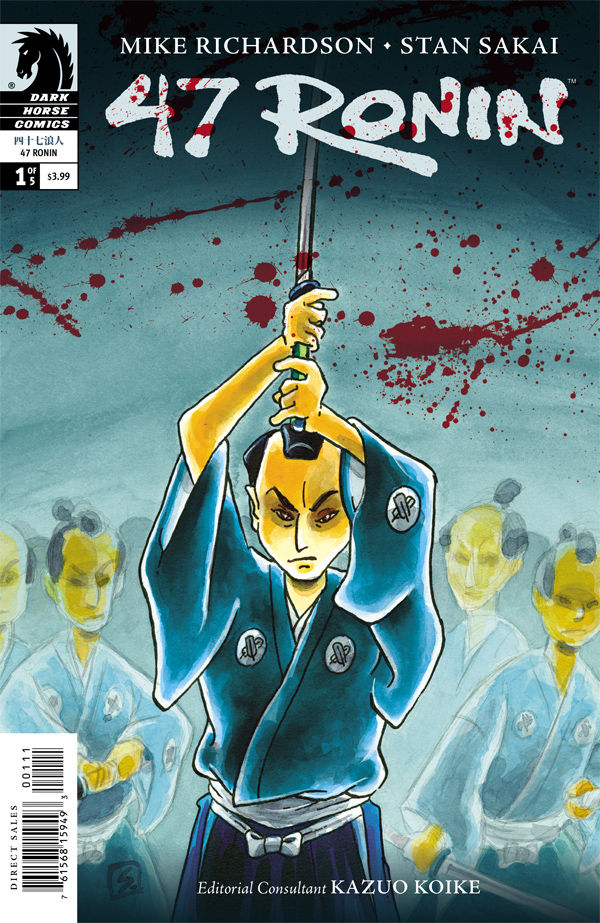 The story of the 47 Ronin is an old Japanese tale. In some strange way, it's almost the Japanese Christmas Carol. Not in the sense that a rich man learns to love life and spread good cheer because he has learned the true meaning of a national holiday, but more to the extent that it has been adapted more times than might possibly be beneficial for the advancement of human civilization. And yet, with every reinterpretation, writers manage to inform a new generation, and find new facets to the story people have not seen before.
It takes place in Feudel Japan during a time much like France during the reign of the Sun King. Lords live at the estates of other lords in a hierarchy geared towards direct control.
One Daimyo from the country is requested to stay with his lord and learn the ways of the court. The young Daimyo is disgusted by the crassness of his lord and does not take his verbal abuse lightly. This leads to a dispute which has become the seminal literary example of what it means to follow the Code of Bushido.
With so many adaptations, is it possible for Mike Richardson and Stan Sakai to breath new life into this story of 47 men who step outside of Japanese law to follow a greater code of honor?
Yes, I believe there is. Having watched several adaptations of the 47 Ronin ("Chushingura" by Hiroshi Inagaki is an excellent one), they all feel somewhat flat. It's all incredibly well composed, but never quite makes a visceral connection with me. It could be lost in the East meets West translation, but beyond story beats, I tend to have trouble caring for the narrative's many characters. In this version, Sakai's art and Richardson's simplistic writing serve the story well. While it might tell a bit more than show, that was an aspect inherent in the original work. When one man chooses to speak the truth in a room full of liars, he must make his actions clear.
While a lot of people influenced by manga have fallen into the trap of pose-etic works of splash-page flash, Stan Sakai is firmly planted in the Osamu Tezuka school of art. While his characters are melodramatic, the setting is first and foremost. These incredibly expressive people live in a world with seasons and live in a world with a sky. There's something refreshing about seeing such attention to setting in a comic book, manga influenced or otherwise. And since the seasons play such an important part of the 47 Ronin story, Sakai really ensures you are able to enjoy them.
Few artists are able to show just how much fun they are having every time they put the brush to paper. Sakai's line is angular, but full of life. He is no stranger to large atmospheric crowd scenes, and this book is full of them. If you always wanted to see Stan Sakai's excellent cartooning, but find talking animals to be somewhat of a deal-breaker, then you definitely need to pick up this book.
Story by Paul Tobin, art by Juan Ferreyra
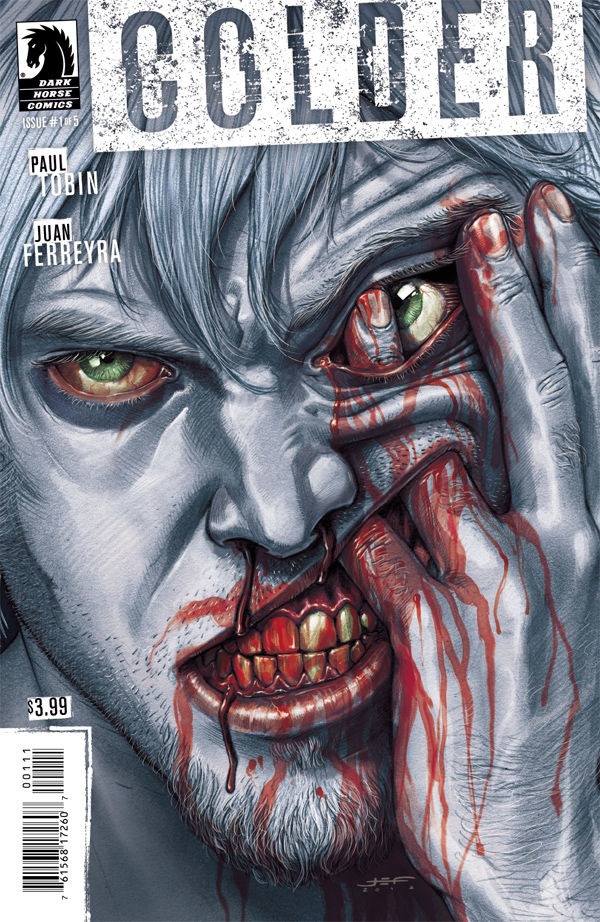 Dark Horse has a foot firmly planted in horror. While they may not have a strong brand for it like Avatar, a media darling like 30 Days of Night, or as robust a back-catalog as Vertigo, their general output tends towards the supernatural (Hellboy anyone?). Colder is the latest addition to the Dark Horse horror family and they promote the book as being "in the vein of Garth Ennis' "Preacher." Which is a very bold statement that may doom this series from the beginning. But Paul Tobin is certainly willing to try and live up to that moniker. But before you pick up this book and start expecting a philosophical debate about Christianity and the nature of God in modern society set against a Spaghetti Western backdrop, you need to put that idea right out of your head. This series (from the first issue anyhow) has seemingly much more in common with Alan Moore's recent Neonomicon (minus the squiggy sex bits). The world these people reside in feels much more like Lovecraft,s Insmouth than Ennis' journey through the "American Heartland." Its horror stems from a person's loss of control and the inability to trust their own mind instead of gore and sexploitation. All of that said, I'm excited to see where this series goes, if Paul Tobin is legitimately telling a lengthy 70+ issue epic, then I will stick with this series till the end.
Story by Victor Gischler, art byJack Herbert
 After Garth Ennis' run on the Shadow came to a startling and quite sudden finale last month, Victor Gischler is given quite a strange place to start his arc... Ennis' Atomic Bomb gave a launch pad for any creator to swoop in and tell whatever tale they have in mind for the eternal man of mystery. Would it be a traditional heist gone awry? Perhaps an attempt on the city's water supply? Maybe stopping a faction of Nazis from gaining a foothold in England? No, Gischler has decided to tell a story that feels like a "Year 1" story, but has to be a "Year 300" story.
The Shadow encounters a man who possesses the same gift to mask people's empathy. He feels lost, as though someone has stopped him from being able to hear or see, but luckily they are masked from each other. Gischler does an excellent job of conveying Cranston's fragile state of mind, and Gischler's fortune cookie wisdom works quite well. But there is a major chronological rub that I don't want to spoil.
I gave Dynamite some credit and said "this is a new version of the character, and what I have known doesn't factor into THIS Lamont Cranston/Kent Allard," but the fact that they reprinted Chaykin's "Shadow: Blood and Judgement" and accepted it as canon, leads me to believe this serious could only take place AFTER those events. By that point, Cranston has encountered so many foes that have been capable of replicating his gifts, this would hardly be new for him. Yet The Shadow, through out the issue, acts as though this is within his first couple years of fighting crime. I can only assume that some editors have some major signals crossed.
I try really hard not to be a giant fanboy when it comes to the Shadow, but it's in my blood. I've been reading his stories, watching his serials, and listening to his radio dramas since I was a tiny tike, and his mythos is something I adore. I have given a lot of leeway to a lot of Shadow stories in the past (accepting Chaykin's Shadow was one of the most rewarding), but Gischler is treading a weird line for me. It's not bad, but he does something a lot of writers who are unfamiliar with the character tend to do, and that's assume he is Batman. Throughout the issue he is seen crouching, and behaving like the Dark Knight, and less like the enigmatic man who scouts out the situation first, then wreaks havoc with his twin .45s of justice! He is smoke, he is a spirit, not a dude that crouches on windowsills. Gischler's over-reliance on The Shadow's inner-monologue also destroys some of the mystery of the character. He is at his best when the reader does not know him, but is seen through the eyes of either victim or villain with only the blood curdling laugh as a warning.
"Dylan, could you hate this issue any more?" Yeah. I probably could. Because I actually enjoyed it a lot. While he "committed a lot of crimes" against my personal Shadow continuity, he managed to sell me on Lamont as a person in his early days as the Shadow and showed me the moment when The Shadow deems it is just fine to take a life. If he can tone down the Bruce Wayne, and amp up the cocky ace fighter-pilot, this could be an excellent series.
Story by Jeff Parker, art by Brian Ching
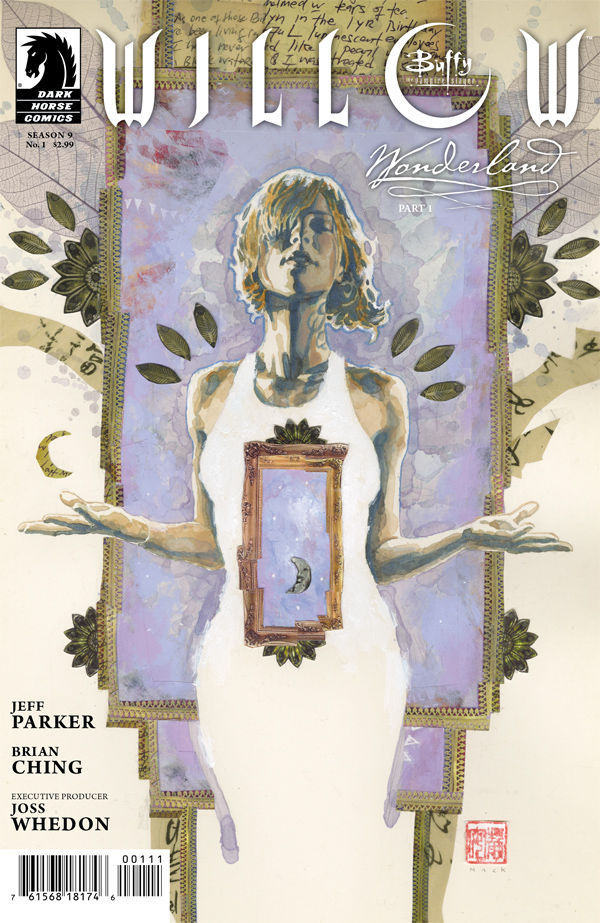 The Buffy-verse has gone through an epic sundering lately, with every character getting their own title. Buffy Season 9 progresses the Slayer's life in the 21st Century with its usual witty satire of popular culture and modern societal norms. Angel & Faith has become the island of misfit toys for all of Buffy & Angel's forgotten yet beloved characters, and Spike's book is... er... a book with Spike in it.
Since Willow hasn't had her own series before, but is such a fan favorite and major player in the Buffy-verse, this series has a bit of anticipation to live up to. Luckily, Jeff Parker is able to deliver. This issue juggles three things rather effortlessly. It ties up where it spins out of Angel & Faith, it presents the reader with everything they need to know about Willow if they have never read or seen any other Buffy stories, AND it sets up the series for the foreseeable future. Jeff Parker gives Willow a task that is big enough that it warrants a solo-series away from everyone else. Willow must dimension hop in order to find a new hold for the Earth's magic after Buffy destroyed it "last season." And as an opening act, Jeff Parker has taken her into the world of Lewis Carrol's Alice in Wonderland. Supposedly, when Lewis Carrol was dreaming up this classic surrealist satire, he was actually visiting this world just beyond our own. Not the most original idea assuredly, but if this series becomes Willow dimension hopping through classic literature and mythology then bring it on, Jeff Parker! I can't wait!
That's it for this week's picks, see you next week for more of my favorite books on the shelves!


